People often say you look sleepy
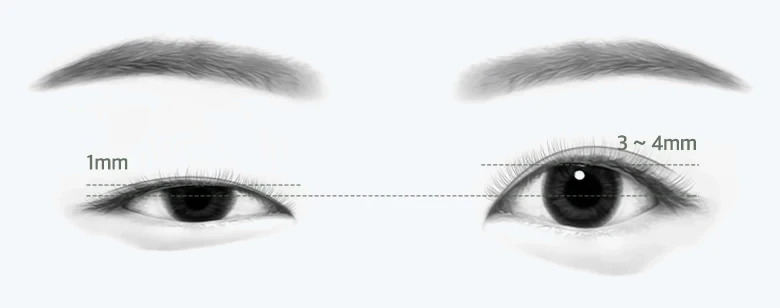
Eyes that look sleepy or heavy often have weaker eye-opening strength (the levator muscle). Ptosis correction adjusts the strength of this muscle so the eyes open more naturally, aiming for a clearer, more defined gaze.
People often say you look sleepy
You raise your eyebrows to open your eyes
The iris looks half-covered
You want brighter eyes with or without a crease
The right method and scope differ by individual condition, so an accurate diagnosis and a personalized plan matter most.
* Results vary between individuals; please confirm recovery time and possible side effects through a thorough consultation.
Answers to the questions patients most often ask before planning surgery in Korea.
QHow is ptosis correction different from double eyelid surgery?
ADouble eyelid surgery shapes the crease, while ptosis correction adjusts the strength of the muscle that opens your eyes, so sleepy-looking eyes open brighter and more clearly.
QIs non-incisional ptosis correction possible?
AYes. Depending on your eyelid condition and the degree of ptosis, non-incisional ptosis correction is also available.
QI heard the eyes may not close fully right after surgery. Is that true?
AMild incomplete closure can appear temporarily right after surgery and generally improves during recovery. The degree and duration vary by individual.
QCan ptosis correction fix uneven eyes?
AYes. By adjusting the lifting strength of each eye separately, we aim to balance the difference between the two eyes.
QHow long does the swelling last?
AMost of the major swelling goes down within 2 weeks to 1 month, and the small visible swelling settles gradually over several months. The pace varies from person to person.
QHow long do I need to stay in Korea after surgery?
AIt depends on your procedure. For typical double eyelid surgery or rhinoplasty, stitches are removed 7-10 days after surgery, so staying at least about one week is standard.
QI do not speak Korean. Do you provide interpretation services?
AWe are a government-registered medical institution for international patients, with dedicated English-, Chinese-, and Japanese-speaking coordinators on staff. They support smooth communication through every step, from consultation to the operating room and aftercare.
QWill the surgeon I consult with actually perform my surgery? Is there any risk of ghost surgery?
AThe board-certified plastic surgeon who consults with you performs 100% of the surgery. Under Korean law requiring CCTV in operating rooms, our operating room CCTV is in operation to protect your rights as a patient.
QWhen can I fly home after surgery?
ACabin pressure changes can cause swelling or bleeding, so it is medically recommended to fly only after your stitches are removed (7-10 days after surgery). Rhinoplasty can be more sensitive to pressure changes, so it is safest to board after a final check with your surgeon.
QHow can I check that a clinic is safe and verified?
AAn objective indicator is the KAHF mark, the accreditation program designated by the Korean Ministry of Health and Welfare for medical institutions serving international patients. You can also verify that the surgeon is a board-certified plastic surgeon on the Korean Society of Plastic Surgeons website.